
|
Getting your Trinity Audio player ready…
|
A Novel By Dipjyoti Sharma

Part Three — Family Opposition
It took four months before her family found out.
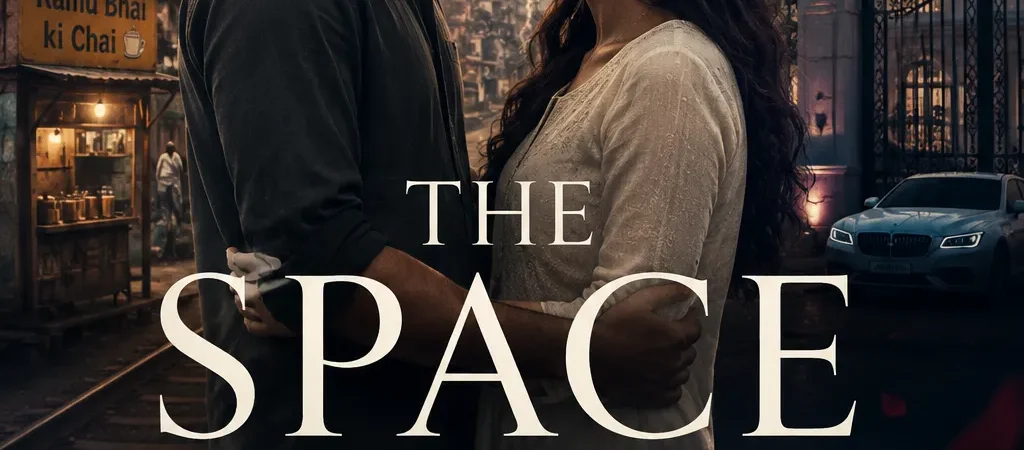
They had been careful. They didn’t post anything. They didn’t appear together in places where people who knew her family might see them. They met at the bookshop, at the chai stall, at small parks in parts of the city that were nobody’s territory. Divya covered for her when necessary.
But someone saw them at a restaurant one evening — a friend of her mother’s, someone who attended all the same parties and visited all the same circles — and by the next morning, Nandini’s mother had heard about it.
She didn’t shout. That wasn’t how it happened.
Sunita Mehta came into Nandini’s room in the evening with a carefully calm expression and sat down on the edge of the bed and said: “I heard you’ve been spending time with a boy.”
Nandini was at her desk. She didn’t turn around. “Who told you?”
“That doesn’t matter. Is it true?”
“Yes.”
A pause. “Who is he?”
“His name is Arjun.”
“His family?”
“He works at an insurance company. His father has a chai stall.”
The silence that followed was the loudest kind of silence — the kind where a person is controlling themselves very carefully.
“Nandini,” her mother said. “You know your father—”
“Don’t tell Papa. Not yet.”
“It’s not something I can hide from him.”
“Amma, please. Just give me time.”
Her mother looked at her for a long moment. Then she stood up and left the room without another word.
Her father’s response was not calm.
Vikram Mehta was a man who had worked hard and had strong opinions about results. He believed in planning. He believed that certain things led to certain outcomes, and that certain people deserved certain outcomes, and that a man who ran a chai stall at a railway station — however decent he might be as a person — did not belong in the same category as the Mehtas.
He called Nandini into his study.
“End it,” he said.
Simple. Flat. Like he was canceling a business arrangement.
“Papa—”
“I’m not asking, Nandini. I’m telling you.”
“He’s a good person.”
“I don’t doubt it. That’s not the point.”
“What is the point?”
Her father looked at her with an expression she knew — patient, unmovable. “You are twenty years old. You are not equipped to understand what this kind of choice means. Not just for you. For the family. For your brother’s prospects. For everything we have built.”
“I’m not ruining anything—”
“You think reputation is nothing.” He leaned forward slightly. “It is everything, Nandini. You think people in our world don’t talk? You think the families we do business with, the families who will consider our son for their daughters — you think they won’t notice?”
She didn’t answer.
“End it,” he said again. “I won’t repeat myself.”
She told Arjun about it the next day.
He listened without interrupting. When she finished, he was quiet for a long time.
“Okay,” he said.
“What does okay mean?”
“It means — I expected this. Didn’t you?”
“Yes.”
“So?”
She looked at him. “I don’t want to end it.”
He looked at the table. “Your father could make things difficult. Not just for you — for my family too. I need you to understand that.”
“I know.”
“My father’s health is not good. If someone puts pressure on the people he depends on — the market people, the suppliers—”
“Arjun, I know.”
“Do you?” He said it without anger, but seriously. “Because knowing and feeling it are different. Right now it feels brave and important. I’m just asking if you’ve thought about what comes after the brave part.”
She looked at him steadily. “Have you?”
A pause. “Every day.”
“And?”
“And I don’t want to end it either.” He rubbed his face with his hand. “Which is probably the worst possible answer.”
“It’s the only answer I wanted.”
Her family escalated slowly.
First, her mother began asking where she was going every time she left the house. Gentle questions, but constant. Who are you meeting? When will you be back? Who else will be there?
Then her phone was checked one evening when she left it on the table and left the room. She came back to find her mother holding it with a complicated expression.
“You didn’t delete any messages,” her mother said.
“No.”
“You’re not hiding it.”
“No.”
Her mother put the phone down. “He writes well. Simply. Like a decent person.” A pause. “It doesn’t change anything.”
Then her father sent Rohan — her younger brother — to talk to her. Rohan was eighteen and he worshipped his father and he sat across from Nandini with a prepared expression and said: “Papa is really serious about this, Didi.”
“I know.”
“He said if you don’t stop, he’ll—” Rohan stopped.
“He’ll what, Rohan?”
“He’ll go to the boy’s father. To his employer. He knows people.”
She felt something cold go through her. “He said that?”
“He said to tell you he has options.”
She said nothing. Rohan looked uncomfortable, like he wanted to leave. He probably did.
“Thanks, Rohan,” she said quietly.
He left quickly.
She sat with that information for two days before she told Arjun.
His face when she told him — she wished she hadn’t had to watch it. Not fear exactly. Something more controlled and more painful. The look of a man calculating how much damage is coming.
“He won’t really do it,” she said, and immediately felt the weakness of the words.
“He might.” Arjun was looking at his hands. “If he contacts my employer, they’ll let me go. They’re a small office. They don’t need complications.”
“I’m sorry.”
“Don’t apologize.”
“Arjun—”
“I said don’t.” His voice was sharp for a second. Then he let out a breath. “Sorry. I just — I need to think.”
They sat in silence. Around them the chai stall was busy — the evening rush, men coming from work, schoolchildren, an old woman selling newspapers.
“We could wait,” he said finally. “Until things settle. Until—”
“They won’t settle. He’ll find someone for me to marry. It’ll happen fast.”
He looked at her.
“I know my father,” she said. “Once he decides something, it moves quickly.”
“What are you saying?”
She met his eyes. “I’m saying if we’re going to do something, we should do it before the decision gets made for me.”
You May like to Read
The Space Between Us – A Heartbreaking Romance About Love, Class Divide & Family Pressure (Part One)