
|
Getting your Trinity Audio player ready…
|
A Novel
Chapter 2
The Woman Behind the White Coat
The podcast studio occupied the corner of the fourth floor of a media building on Kasturba Gandhi Marg, a five-minute walk from Connaught Place’s inner circle. It was a room designed to encourage honesty — warm yellow light from desk lamps rather than overheads, dark acoustic panels on the walls that absorbed sound rather than bouncing it back, a round table instead of a long rectangular one, two chairs of equal height facing each other so no one sat above and no one below. There was a glass wall on one side looking into the main office. On the other three sides, quiet.
The engineer, a young man named Karthik who had been operating recording equipment since he was nineteen, had set up the room before they arrived. Two microphones on the table, angled carefully. A jug of water. Two glasses. A small dish of hard candy that no one ever ate but that Karthik put out every session because it was on the setup list and he was thorough.
Arjun sat across from Priya Mehta. He had removed the Padma Shri medal and placed it on the table between them, where it sat in the lamp light catching the gold and blue enamel. He had not been entirely sure why he removed it, only that wearing it in here felt like a particular kind of performance he was not interested in. The medal on the table was different. It was a fact on the table. An object that had weight and history and a story attached to it.
Meera had stayed in the car downstairs. She had waved away his question about coming up.
“I have not heard you talk for forty years in order to listen to you for one more hour in a studio. Go.”
He had laughed — a real laugh, quick and genuine — and she had almost smiled. He carried that almost-smile with him into the building.
Karthik’s voice came through a small speaker: Ready when you are.
Priya looked at Arjun. He nodded. Recording began.
~ ~ ~
Priya’s introduction was precise and unhurried. She named the degrees, the positions, the awards, the publications, the surgeries, the international recognitions. She named the International Neurosurgery Excellence Award. She named the first-in-India procedures. She named the number of students he had trained who were now leading neurosurgery departments across the country.
Arjun listened with a slight, distant expression. He had heard his biography read aloud many times over thirty-eight years — at award ceremonies, at conference introductions, at the beginnings of lectures. He had never known exactly what to do with these readings. They were accurate. They described, correctly, the facts of his professional life. They were also, in a fundamental way, about someone he barely recognized — a person assembled from achievements and credentials who bore a distant relationship to the actual man who got up every morning and ate breakfast and worried and made mistakes and held the people he loved and sometimes failed to hold them enough.
When Priya finished and the recording light stayed green, she put down her notes and leaned forward.
“Dr. Kumar. This morning at Rashtrapati Bhavan, you said something that stopped a room of eight hundred people. You said the concept of being self-made was the biggest lie of your life. You said nobody sees the woman who built you. I have been a journalist for eight years and I have covered a great many award ceremonies and I have heard a great many acceptance speeches. I have never heard one quite like that. Can you begin there? What made you say it today, after this long?”
Arjun picked up his water glass. Set it down.
“Two reasons. The first is age. I am sixty-five. I have spent much of my life doing the thing that driven professional people do — working so hard at what you are building that you do not stop to properly account for what it cost. Or who paid the cost. It is not dishonesty, exactly. It is a kind of preoccupation. You tell yourself you will address it later. You will say the right things when the time is right. And then forty years pass and you realize that later keeps becoming never if you are not careful.”
He paused.
“The second reason is her. Meera. She sat in that front row this morning in a dark blue saree she has had for three years and would not replace when I asked her to, and she watched me receive that medal, and I watched her watching me, and I thought — if I stand at that podium and give the usual speech, I will be lying. Not by commission. By omission. I will be committing the same lie I have been committing for forty years by not saying the full truth aloud.”
“What is the full truth?”
Arjun reached into his jacket pocket. He brought out the photograph.
It was small and old. The paper had the soft texture of photographs that have been handled many times. The corners were bent, rounded by decades of being in his wallet, in his drawer, in his jacket pocket. He placed it flat on the table between him and Priya.
She looked at it.
A young woman, perhaps sixteen or seventeen years old. Dark eyes that held the camera directly, without performance. A half-smile that was almost not a smile — more the expression of someone who has just thought of something and has decided not to say it yet. She was standing against a mud wall, holding two notebooks pressed against her chest in the way that students hold books — not carrying them but holding them, as if they were something she needed to keep close. On the ground beside her feet, a small kerosene lantern with a cracked glass panel. Behind her, darkness.
“Who is this?”
“Her name is Meera. She is my wife. She has been my wife for forty-three years. She was seventeen in this photograph. And she is the reason I am sitting in this studio today, with that medal on that table, instead of farming a piece of land in Uttar Pradesh.”
“What did she do?”
The question was simple and it landed in the room with the weight of a stone dropped into still water.
Arjun looked at the photograph on the table.
“She gave up everything she was supposed to become so that I could become what I became. She was the smartest person in our village — not the smartest girl. The smartest person. She scored 96.2 percent on her class ten board examination. First in the district. She loved science with the specific love that people have for things that feel to them entirely natural. She was, in that village, at that time, an accident of nature. A mind like that, in a place like that, was an accident.”
He looked at the photograph.
“And accidents, in places like that, are usually corrected.”
The studio was very quiet. Outside the glass wall, the office had gone still. Several people had drifted closer to the glass, standing with their coffee cups forgotten, looking in at an old surgeon talking into a microphone about a photograph of a girl in front of a mud wall.
“Let me start from the beginning,”
Arjun said.
“Her name was Meera Prasad. She was born in a village called Rampur Khas, about sixty kilometers from Lucknow, in 1962. And I want you to understand — really understand, not just as an abstract fact — what that means. What it means to grow up knowing that your future has already been decided before you were old enough to want anything else. And what it means for a mind like hers to exist in that geography.”
The room was waiting.
He breathed in.
He began.
You May Love to Read
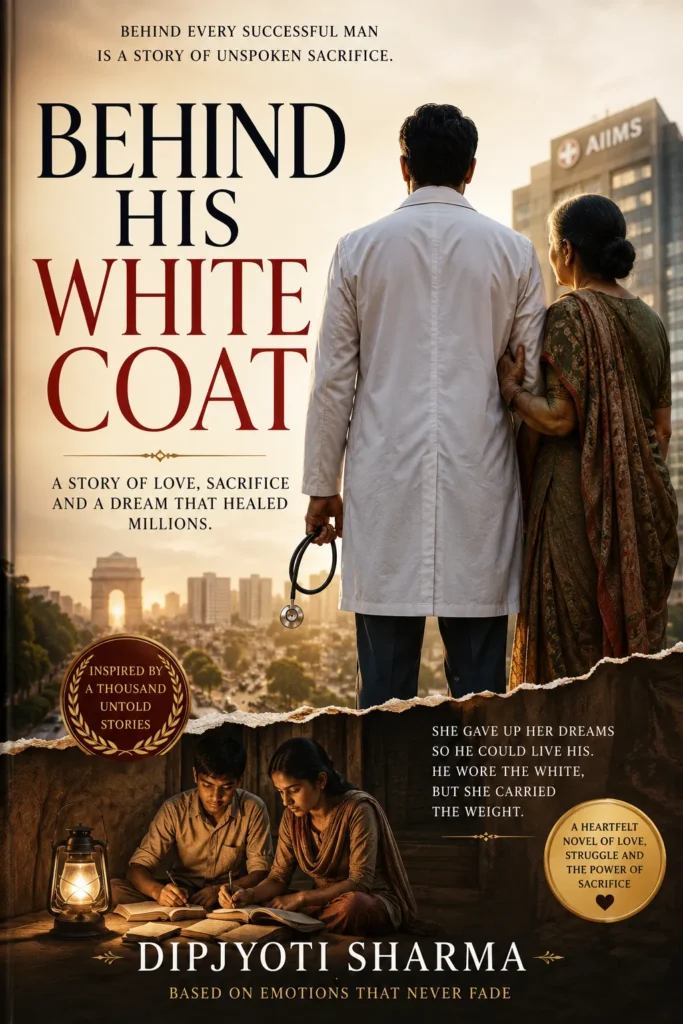
BEHIND HIS WHITE COAT A Story of Love Chapter 1