
|
Getting your Trinity Audio player ready…
|
The Man Inside the White Coat
Time in a life is not the same as time in a story.
In a story, twenty years can be a sentence. In a life, twenty years is twenty years — seven thousand three hundred mornings of waking up, thirty meals a week, four seasons repeated twenty times, the accumulated ordinary of a life being lived in real time, at the speed of real time, which is the speed of everything.
Between the end of his residency and the morning of the ceremony at Rashtrapati Bhavan, Arjun Kumar lived thirty-eight years of medicine.
He completed the residency and joined AIIMS as a junior consultant. He was twenty-nine. He was terrifyingly young for the position and terrifyingly competent for someone terrifyingly young, and both of these things were noted by the department, which dealt with it by giving him the difficult cases and watching very carefully what he did with them.
He did extraordinary things with them.
The first case that brought him to attention outside AIIMS was a thirty-four-year-old woman with a brainstem cavernoma — a cluster of abnormal blood vessels in one of the most inaccessible and dangerous locations in the brain. Two other hospitals had declined to operate. The risk was real and had been explained clearly to the patient. She had asked if there was a surgeon who would try. Her family had brought her to Arjun.
He looked at the MRI for three days. He designed the approach in his mind repeatedly, discarding what would not work, refining what might. He spoke to Dr. Varshneya. He looked at the MRI a fourth day.
He operated on the fifth day.
Seven hours and forty minutes. The cavernoma was removed completely. The patient woke without deficit.
She sent him a letter eighteen months later. She had a daughter, born the previous year. She had named the daughter Arjuna. He kept the letter. He still had it.
~ ~ ~
The career built over years the way careers build when they are built on genuine skill and genuine work: not in sudden leaps but in the steady accumulation of cases and papers and procedures and reputation.
He became Associate Professor. Then Professor. Then Head of the Department. As Head, he ran the neurosurgery department the way he ran his operating room: with a complete intolerance for preventable error and a complete understanding that human beings make non-preventable errors. He was respected, widely, and not entirely comfortable. The residents in his department did not find him warm but found him fair, which was rarer and more useful. His students learned more from him than from anyone else because he was not interested in performing competence for them but in actually transferring it.
He went to conferences in London, in Tokyo, in Boston, in São Paulo. He gave lectures in the clear, particular English he had built over decades — not the English of his birth but one he had constructed word by word, accent by accent, that was now entirely his own. He presented findings. He argued positions. He listened to disagreement and responded to it, sometimes changing his view and sometimes not, always on the basis of evidence.
He published sixty-two peer-reviewed papers over thirty-eight years. The paper he was most proud of was a 2006 paper on modified approaches to pediatric posterior fossa tumors — twelve cases, outcomes significantly better than the prevailing standard. Three other teams in three countries had written to him after it was published. Two had adopted his approach. Twelve children, and the children of those twelve children who would not exist if the surgery had not been possible, and the surgeons who learned the technique and used it on twelve more, and then twelve more. The arithmetic of medicine was unlike any other arithmetic.
~ ~ ~
The International Neurosurgery Excellence Award came when he was fifty-three.
The letter arrived in February. He read it twice, folded it, and returned to the scans on his desk. His department had a party. Residents brought a cake. Someone put a banner in the corridor. Arjun cut the cake and thanked everyone and went back to the ICU to check on a patient who had come out of surgery four hours earlier and whose post-op course he was watching carefully.
He told Meera at dinner.
“There is a neurosurgery award from the international society.”
“Which one?”
“The Excellence Award.”
She put down her fork. She looked at him.
“The one you said no one from this country had ever received.”
“Yes.”
She picked up her fork again. She looked at her plate. Then back at him.
“Arjun.”
“Hmm.”
“This is enormous.”
“Yes.”
“You don’t look like someone who has just received an enormous thing.”
“I don’t know how to look like that.”
She looked at him with the expression that was both affectionate and faintly exasperated — the expression of a woman who has been watching someone underreact to his own achievements for thirty years.
“Accept it properly. At the ceremony. Give a real speech.”
“I give proper speeches.”
“You give efficient speeches. Not the same thing.”
He had laughed. She had almost smiled. The ceremony was in London. He went and gave a speech. It was, by his standards, relatively warm. Meera had suggested three specific things to include. He included all three.
~ ~ ~
The money had changed things over the years.
Not suddenly. Academic medicine does not make you wealthy overnight, and the years of training and junior positions had been years of modest income. But over decades of professorship and consulting fees and foreign lectures, the accumulation became real.
The first good thing he bought for Meera was a silk saree. He had seen it in a shop in the market — deep red with a gold zari border, entirely beyond their means for the first fifteen years of their marriage. He bought it and brought it home and placed it on the bed.
She picked it up and held it for a moment.
“This is very expensive.”
“Yes.”
“We don’t need—”
“I know we don’t need it. That is precisely the point. We don’t need it and I bought it. That is allowed now.”
She looked at him. Then at the saree. Then at him again.
“Thank you,”
she said. Simply, genuinely, without performance.
He bought more sarees after that — not many, but over years, the occasional saree for the occasion that deserved it. He bought her jewelry. Not elaborate — she was not an elaborate woman. Small, precise, beautiful things. A pair of gold earrings with a design she had once pointed at in a shop window, years ago, saying nothing, simply looking. He had remembered. He bought them three years later. She wore them still.
He bought her a chair. This was not glamorous. But the chair she had been sitting in for reading was causing her back pain and she had mentioned it once, neutrally, not as a complaint, and he had bought a proper chair with good support for the reading corner of the living room. She had sat in it for a long time when he brought it home, adjusting the angle, moving it slightly, testing it.
“This is a good chair,”
she said.
“Yes,”
he said.
She looked at him with the expression that understood what was being said underneath the surface of the sentence, and she nodded.
~ ~ ~
Their son Rohan was born in the sixth year of their marriage, when Arjun was in the second year of his residency.
The pregnancy had been managed by Meera with the same systematic practicality she brought to everything — she had continued working at the accounting job until the eighth month, had arranged everything for the arrival, had been completely composed at the hospital in a way that impressed the nurses and mildly alarmed the attending physician, who was accustomed to some degree of visible anxiety.
Arjun had been called out of an on-call shift when labor began. He arrived at the hospital in his scrubs. He held Meera’s hand through the delivery. When Rohan arrived — seven pounds, healthy, with his father’s hands and his mother’s eyes — Arjun had looked at this new person and felt something categorically different from anything he had felt before. Not love exactly — he had loved Meera for years and knew what love felt like. Something else. Something about the sheer fact of this person’s existence, the improbability of it, the specific chain of choices and accidents and bus rides and river temples and kerosene lamps that had had to happen exactly as they happened for this particular small person to arrive in this particular room.
He cried. Meera, exhausted to the point of trembling, watched him cry and said, in a voice that was tired and warm and entirely herself:
“So you are capable of it after all.”
Kavya came three years later. She was calmer than Rohan from the beginning, with a watchful quality to her attention that he recognized immediately. She grew up in a household that was stable and affectionate and intellectually alive — Meera’s reading had never stopped, and neither had her intelligence, and both children grew up in the company of a mother who asked good questions and listened to the answers fully and never treated their curiosity as inconvenient.
Rohan became a civil engineer and moved to Pune. Kavya became a general physician and set up a practice in a smaller city in Rajasthan because, she said, there were not enough doctors who stayed in one place long enough to know their patients’ full histories.
When Kavya said this, Meera looked at her daughter for a long moment and said: yes. That is the right reason.
~ ~ ~
The question of what Meera had lost was one Arjun thought about often.
He asked her directly, once. They had been married fifteen years and he asked it on an evening when they were sitting in the living room after dinner, in the comfortable quiet of long-married people who have had all the urgent conversations and are now in the territory of the reflective ones.
“Do you regret it? Not studying. Not becoming what you might have become.”
She was quiet for a long time.
“I want to answer this honestly rather than quickly.”
“Take your time.”
She sat with the question for several minutes. He waited.
“Regret assumes that there is a parallel life somewhere that was better. That there is a version of Meera who became a doctor or a scientist and whose life was therefore more fully realized. I am not sure that person would be better. I think she would be different. Different, and perhaps more obviously accomplished in the ways the world measures accomplishment. But I am not sure she would be more fully herself. This life — our life, the one we built from those two cloth bags and that river temple and that borrowed stove — this life has a specific character that I could not have had in any other way. And I have, in this life, been more fully myself than I think that other Meera might have been. She would have had credentials. I have experience. Both are real. I have chosen not to spend my time mourning the credentials.”
He was quiet.
“If you say that is a very philosophical answer I will be annoyed.”
“I was going to say impressive.”
“Then say it.”
“That is a very impressive answer.”
“It is also honest. The honest things always require more thought than the quick answers.”
He had held this answer for years. He turned it over many times. He believed it — believed that she believed it, believed there was genuine truth in it. But he also knew Meera well enough to know that she could hold a grief quietly and without performing it, that the absence of expressed grief was not always the absence of grief. He had decided, years ago, that this was not something he could resolve on her behalf. It was hers to hold however she chose to hold it. His job was to see it. Not look away. See it and carry his part of it and not pretend it did not exist.
~ ~ ~
In her sixties, Meera began painting.
It started when Kavya gave her a small watercolor set for her birthday. The first paintings were cautious — a cup, a flower, the view from the window. She worked at the table in the kitchen with newspaper spread underneath, in the early mornings before the house was fully awake, which meant she was simply doing what she had always done: taking the early hours for herself.
The paintings improved. Not dramatically — she was not a prodigy, and she had started late. But they became recognizable, then competent, then occasionally genuinely beautiful. The subjects were specific: village scenes she had not seen for forty years, existing only in her memory now, painted with a precision that was both the precision of her general mind and something else — a quality of attention that came from looking at something you love and miss while knowing you cannot go back.
There was a series of them. A well. A tree at the edge of a field. A particular quality of light over flat land in the late afternoon. An earthen courtyard with a fire burning in it. He looked at them sometimes when she was not watching.
He thought: this is what she has been carrying. Not in grief — she was not a woman who performed grief or privately indulged it. But carrying, the way all of us carry the specific geography of childhood, the specific light of the place that made us.
She sold four paintings at a neighborhood community exhibition and was genuinely surprised and quietly pleased. She put the money — four hundred and fifty rupees — toward a new set of watercolor paper. He watched her do this. He thought: she is the most complete person I know. Not because her life has been easy. But because she has never stopped building herself from whatever materials were available. That is what completion looks like. Not the absence of loss. The continued building in spite of it.
He had been given, in his life, the gift of being married to a person who was genuinely extraordinary. He had spent forty years not saying this loudly enough. He intended to correct this.
You May Love to Read
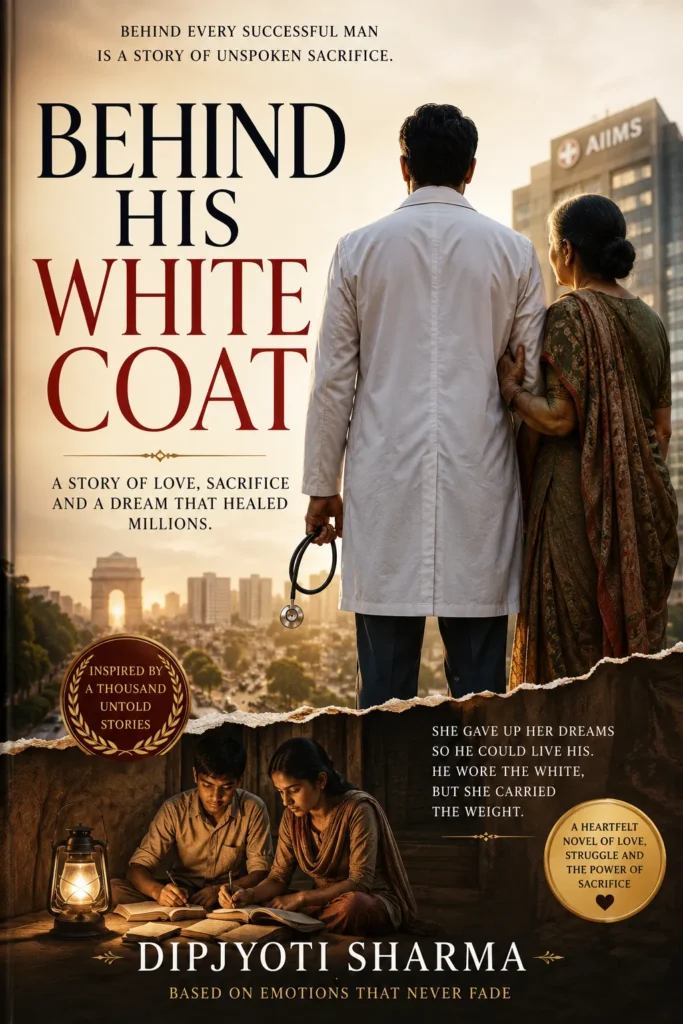
BEHIND HIS WHITE COAT A Story of Love Chapter 1
BEHIND HIS WHITE COAT A Story of Love (Chapter -2)
BEHIND HIS WHITE COAT A Story of Love (Chapter -3)
BEHIND HIS WHITE COAT A Story of Love (Chapter -4)
BEHIND HIS WHITE COAT A Story of Love (Chapter -5)
BEHIND HIS WHITE COAT A Story of Love (Chapter -6)
BEHIND HIS WHITE COAT A Story of Love (Chapter -7)
BEHIND HIS WHITE COAT A Story of Love (Chapter -8)
BEHIND HIS WHITE COAT A Story of Love (Chapter -9)