
|
Getting your Trinity Audio player ready…
|
A story of Kolkata, Durga Puja, and a promise kept on the last night
The Boy Who Sat Alone
Every year, when the monsoon ended and the sky turned bright blue, the lanes of north Kolkata filled with the sound of drums.
That year, the Shyambazar Sarbojanin pandal was the most beautiful in the neighborhood. Its roof was made of paper lanterns, and the goddess Durga stood inside, ten-armed and shining, with her lion beside her. Thousands of people came to see her. They wore new clothes, ate sweets, and laughed under the lights.
But Mitu, who was ten years old and lived in the house across the lane, noticed something strange.
Every evening at six o’clock, a little boy came and sat on the same low stone step, just outside the pandal gate. He was about eight years old. He wore a faded blue shirt that was too big for him. He held a small cloth bag in his lap, and he did not go inside to see the goddess. He did not play with the other children.
He only sat and watched the crowd, looking carefully at every face.
The Neighbors Start to Wonder
By the third day, everyone in the lane had noticed him.
“Whose child is that?” asked Mrs. Dutta, the old widow from the corner house.
“Nobody knows,” said Mr. Sen, the secretary of the puja committee. “He doesn’t speak much. I asked him his name once, and he only said, ‘Bubai.’”
“Is he lost?”
“I asked that too,” Mr. Sen said. “He shook his head. He said, ‘I’m waiting.’”
The whole lane began to guess whom the boy was waiting for. Some thought it was his mother, who must have gone shopping and forgotten him. Others said it was a teacher, or an uncle. The sweet seller, Gopal-da, believed it was a dog that had run away.
But no one could say for sure. And little by little, without making any plan, the neighbors began to look after him.
Gopal-da sent over a clay cup of sweet yogurt every evening. Mrs. Dutta brought a shawl when the nights grew cool. The dhunuchi dancers nodded to him as they passed. Mr. Sen moved a plastic chair beside the stone step, in case the boy wanted to sit more comfortably, but Bubai only smiled and stayed on the stone.
Mitu Asks
On the evening of Ashtami, the eighth day, the sky turned gray and a soft rain began to fall. People ran for shelter under the pandal’s roof. But Bubai stayed where he was, with the cloth bag held tight against his chest.
Mitu could not bear it. She took her small red umbrella, crossed the lane, and sat down beside him.
“You’ll get sick,” she said, holding the umbrella over both of them.
Bubai looked at her. His eyes were big and tired. “I’m okay.”
“Who are you waiting for?”
He was quiet for a long time. Rain tapped on the umbrella.
“My baba,” he said at last.
“Where is he?”
“He works far away. In a big city across the sea. He builds roads there.” Bubai held up the cloth bag. “Last year, before he left, he took me to this pandal. He lifted me on his shoulders so I could see Maa Durga’s face. He said, ‘Next year, on the last night of Puja, I will come back. Look for me at the gate, Bubai. I’ll find you.’”
He opened his bag. Inside was a small, slightly crushed paper lantern, bright orange.
“He bought me this. So I would remember.”
Mitu felt her throat grow tight. “And he hasn’t come yet?”
“He said the last night,” Bubai said. “That’s Dashami. He never breaks a promise.”
A Quiet Worry
Mitu told her mother everything. Her mother told Mrs. Dutta, and Mrs. Dutta told Mr. Sen. By the next morning, the whole neighborhood knew the boy’s story.
But the news brought a new worry.
“Where does he live?” Mr. Sen asked. “Who looks after him?”
It turned out that Bubai lived with his aunt, a kind but very tired woman who worked long hours as a cook in three different houses. She knew he came to the pandal every night. She had let him go, because it was the only thing that made him happy.
“His mother died when he was small,” she told Mr. Sen quietly. “His father went abroad to earn money for the boy’s school. He calls sometimes. But I haven’t heard from him in two weeks. His phone is off.”
Mr. Sen did not say what everyone was thinking. A man could be delayed. A man could be sick. A man could, sometimes, simply not come back.
On the ninth day, Nabami, the committee tried every number they could find. No one answered.
That evening, Bubai sat on his stone step as always. The lane was louder than ever, full of drums and laughter. But the neighbors watched him with heavy hearts, and nobody smiled much.
The Last Night
On Dashami, the final day, the goddess would be carried to the river and given a farewell. It was the saddest and the most beautiful night of the festival. Women in red-bordered white saris smeared red sindoor on each other’s faces. The dhakis played their biggest drums. Everyone cried a little, and everyone laughed a little too.
Bubai came at six o’clock, as always.
But this time, the whole lane came with him.
Mrs. Dutta sat on a chair beside him. Gopal-da brought a plate of sweets and refused to take any money. Mitu held his hand. Mr. Sen stood near the gate with his arms folded, looking up the lane again and again.
The hours went by. The sky grew dark. The drums began to beat faster.
At eight, the men lifted the great statue of Durga onto a truck. At nine, the crowd began to move toward the river, singing and shouting, “Asche bochhor abar hobe!” Next year, it will happen again!
Bubai stood up slowly. His small shoulders sagged. He looked at his orange lantern.
“Maybe he’s still on the way,” he whispered. But his voice shook.
Mitu did not know what to say. She held his hand tighter.
The truck began to roll forward. The crowd started to follow.
And then, from the far end of the lane, came a voice.
“Bubai!”
The Man at the Gate
Everything seemed to stop. The drums, the singing, even the wind.
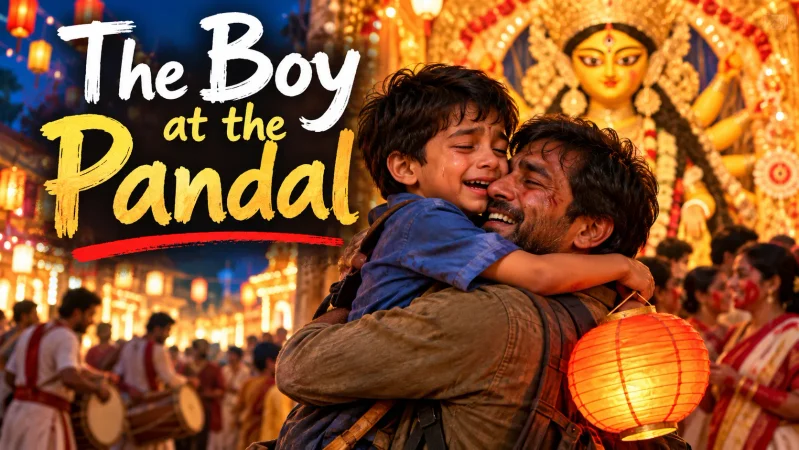
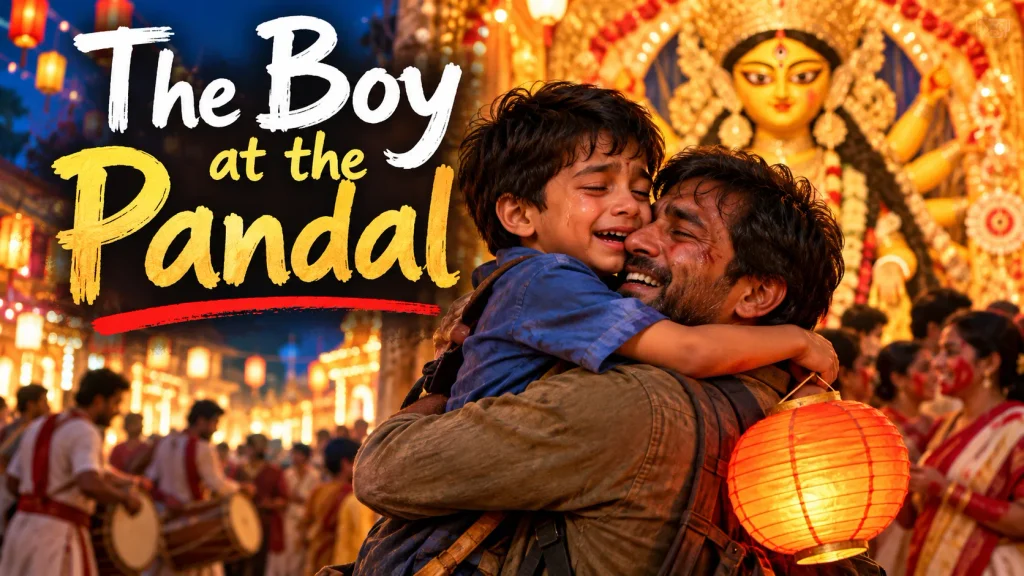
A man was running down the lane, pushing through the crowd. He was thin and dusty, carrying a big bag on his back. His shirt was wrinkled and damp with sweat, and his eyes were wet.
“Bubai! Bubai!”
The boy turned. For one moment, he did not move. Then the cloth bag fell from his hands.
“Baba!”
He ran. The man dropped to his knees and caught him in both arms, holding him so tightly that the lantern crushed between them.
“I’m sorry,” the man kept saying, over and over. “My flight was cancelled. Then my phone broke. I took three trains and a bus. I’m so sorry, my boy. I’m so sorry I’m late.”
“You’re not late,” Bubai said, his face buried in his father’s shoulder. “You said the last night. It’s still the last night.”
The father laughed and cried at the same time. “Yes,” he said. “Yes, it is.”
Around them, the whole lane was crying too. Mrs. Dutta wiped her eyes with the end of her sari. Gopal-da blew his nose loudly. Mr. Sen turned away and pretended to look at the sky. Mitu was smiling so hard that her cheeks hurt.
Then someone began to play the dhak. Soft at first, then louder, then joyful. The crowd started to clap. The old women began to dance.
Carrying the Goddess Home
That night, Bubai rode to the river on his father’s shoulders, just like last year.
From up there, he could see everything: the glowing lanterns, the dancing crowd, and Maa Durga at the front of the procession, her ten arms raised to the sky. As the truck moved slowly down the lane, he leaned over and whispered in his father’s ear.
“I asked her to bring you home.”
His father held his legs tight and did not answer. He could not speak.
At the river, the crowd sang the goddess goodbye. Boats rocked in the dark water. The great statue slid slowly into the river, and the lanterns floated around her like tiny stars.
Bubai held his orange paper lantern tightly. When the moment came, he lifted it up high, then handed it to his father.
“Keep this,” he said. “So you remember.”
His father kissed the top of his head. “I will never forget,” he said. “I promise.”
Next Year
The father stayed in Kolkata for one month. Then he found a job on a new road project in the city, so he would never have to leave again.
The next year, when the drums began to beat and the lanterns lit up the lane, Mitu looked across the street, out of habit, toward the old stone step by the gate.
The step was empty.
Because Bubai was inside the pandal, standing on his father’s shoulders, looking up at the goddess’s face, and smiling.
Some people, it turns out, are late. But love still waits at the gate, and sooner or later, it finds the way home.
You May Love to Read
BEHIND HIS WHITE COAT A Story of Love Chapter 1
BEHIND HIS WHITE COAT A Story of Love (Chapter -2)
BEHIND HIS WHITE COAT A Story of Love (Chapter -3)
BEHIND HIS WHITE COAT A Story of Love (Chapter -4)
BEHIND HIS WHITE COAT A Story of Love (Chapter -5)
BEHIND HIS WHITE COAT A Story of Love (Chapter -6)
BEHIND HIS WHITE COAT A Story of Love (Chapter -7)
BEHIND HIS WHITE COAT A Story of Love (Chapter -8)
BEHIND HIS WHITE COAT A Story of Love (Chapter -9)
BEHIND HIS WHITE COAT A Story of Love (Chapter -10)
BEHIND HIS WHITE COAT A Story of Love (Chapter -11)