
|
Getting your Trinity Audio player ready…
|
The village of Sakura stood quietly between the mountains of northern Japan.
Years ago, it had been full of life.
Children ran through the streets.
Farmers worked in the fields.
Families gathered beneath cherry blossoms every spring.
But those days were gone.
The young people had left for Tokyo, Osaka, and other big cities.
One by one, homes were abandoned.
Their wooden doors remained locked.
Their gardens turned wild.
Their windows gathered dust.
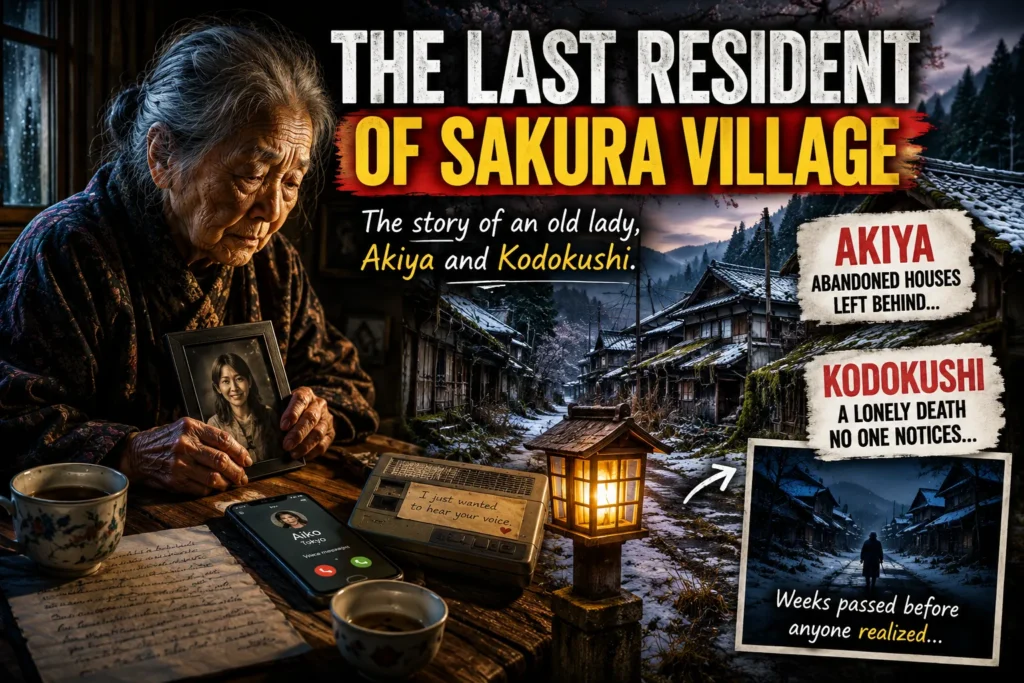
The villagers called these empty homes Akiya.
There were dozens of them now.
And among all those silent houses lived an eighty-year-old widow named Yumi Nakamura.
She was the last person living on her street.
Every morning, Yumi woke before sunrise.
She swept the front porch.
Watered the flowers.
And lit incense before a photograph of her late husband, Hiroshi.
Then she made two cups of tea.
One for herself.
And one for the man who had been gone for twelve years.
The second cup always sat untouched.
Yet Yumi never stopped preparing it.
It made her feel that Hiroshi was still with her.
Outside her window stood a row of Akiya houses.
Some had been empty for ten years.
Others for twenty.
At night, the abandoned homes looked like dark shadows watching over the village.
Sometimes Yumi wondered if her house would become another Akiya one day.
The thought frightened her.
Her daughter, Aiko, lived in Tokyo.
In the beginning, Aiko visited every summer.
Then every few years.
Then only phone calls.
Life in the city was busy.
Work became demanding.
Children needed attention.
Years slipped away.
Still, Yumi never complained.
Whenever neighbors asked about her daughter, she smiled proudly.
“Aiko is doing well,” she would say.
But every evening she looked at the road leading into the village.
Just in case.
Just in case her daughter came home.
One autumn afternoon, Yumi received a voicemail.
It was from Aiko.
“Hi Mom. I’m sorry I missed your call. Things are very busy right now. I’ll visit soon, I promise. Love you.”
Yumi listened to the message.
Then she listened again.
And again.
Soon it became part of her daily routine.
Every night before sleeping, she played the message and smiled.
The sound of her daughter’s voice filled the empty house.
For a few moments, she didn’t feel alone.
Winter arrived.
Heavy snow covered Sakura Village.
The roads became difficult to travel.
Most days, Yumi saw no one.
Only snow.
Silence.
And the dark Akiya houses.
One evening, she walked outside carrying a lantern.
Its warm glow illuminated the snowy street.
Against the darkness of the abandoned homes, the small light seemed almost magical.
As long as her lantern shined, the street did not feel completely empty.
The villagers began calling it “Yumi’s Light.”
It became a symbol of life in a place slowly fading away.
Months passed.
Then one morning, Yumi woke feeling weak.
Her hands trembled.
Her body ached.
At first she ignored it.
But each day she grew weaker.
She stopped tending her garden.
The flowers began to die.
The snow melted and spring arrived.
Yet Yumi rarely left her bed.
One evening she picked up her phone and called Aiko.
There was no answer.
She listened to her daughter’s old voicemail one more time.
Then she left a new message.
“Hello, Aiko.”
Her voice was soft.
“I just wanted to hear your voice.”
She paused.
“If you’re busy, that’s okay.”
Another pause.
“I miss you.”
Her eyes filled with tears.
“But I am proud of you.”
She forced a smile.
“Take care of yourself.”
The message ended.
It was the last thing she ever recorded.
Days passed.
The lantern outside her house no longer appeared at sunset.
For the first time in years, the street was completely dark.
The Akiya houses stood silently beneath the moonlight.
Nobody noticed at first.
The village had become too empty.
Too quiet.
Weeks later, a postal worker arrived.
He immediately felt something was wrong.
The mailbox overflowed with letters.
Newspapers were piled near the door.
The flowers had withered.
And Yumi’s lantern remained dark.
The man contacted local authorities.
Together they entered the house.
Inside, they found Yumi sitting peacefully in her chair.
A family photograph rested in her hands.
Beside her stood two cups of tea.
One empty.
One untouched.
The entire region mourned her death.
Newspapers called it another case of Kodokushi—a lonely death.
But the people of Sakura Village knew it was more than that.
Yumi was not just another statistic.
She was the last light of a disappearing community.
When Aiko received the news, she rushed to the village.
The moment she entered her mother’s home, she broke down in tears.
Everything was exactly as Yumi had left it.
The flowers.
The photographs.
The teacups.
The voicemail on the phone.
With shaking hands, Aiko pressed play.
“Hello, Aiko… I just wanted to hear your voice…”
Aiko fell to her knees.
For the first time, she truly understood how lonely her mother had been.
That night she walked outside carrying the old lantern.
The street was dark.
The abandoned Akiya houses surrounded her like silent memories.
Slowly, she lit the lantern.
A warm golden glow spread across the road.
And for a moment, it felt as though her mother was standing beside her.
Months later, Aiko made a decision.
She refused to let the village disappear.
She bought several nearby Akiya houses and restored them.
One became a community center.
Another became a café for elderly residents.
A third welcomed volunteers who came to help older villagers.
Above the entrance, she placed a wooden sign.
It read:
“No One Should Grow Old Alone.”
Over time, visitors returned.
Families came back.
Some restored abandoned homes.
Others simply stayed to listen to the stories of the elderly.
Slowly, life returned to Sakura Village.
Years later, travelers would often ask about the lantern shining each evening among the old Akiya houses.
The villagers would smile and tell them about Yumi Nakamura.
The woman who spent years waiting.
The woman whose lonely death awakened an entire community.
The woman whose light never truly went out.
Because although Yumi died alone, her story ensured that others would not.
And in the end, that small lantern became something greater than a light.
It became a promise.
A promise that nobody would ever be forgotten again.
Read Also
➡️ Holi in a Hospital: A Heartwarming Story of Kindness and Second Chances
A touching tale of compassion, hope, and unexpected friendship that changes lives forever.
https://dipjyotisharmabooks.com/holi-in-a-hospital-a-heartwarming-story-of-kindness-and-second-chances/
➡️ Emotional Short Story: The Letter He Never Opened
A powerful emotional story about regret, forgiveness, and the importance of cherishing loved ones before it’s too late.
https://dipjyotisharmabooks.com/emotional-short-story-the-letter-he-never-opened