
|
Getting your Trinity Audio player ready…
|
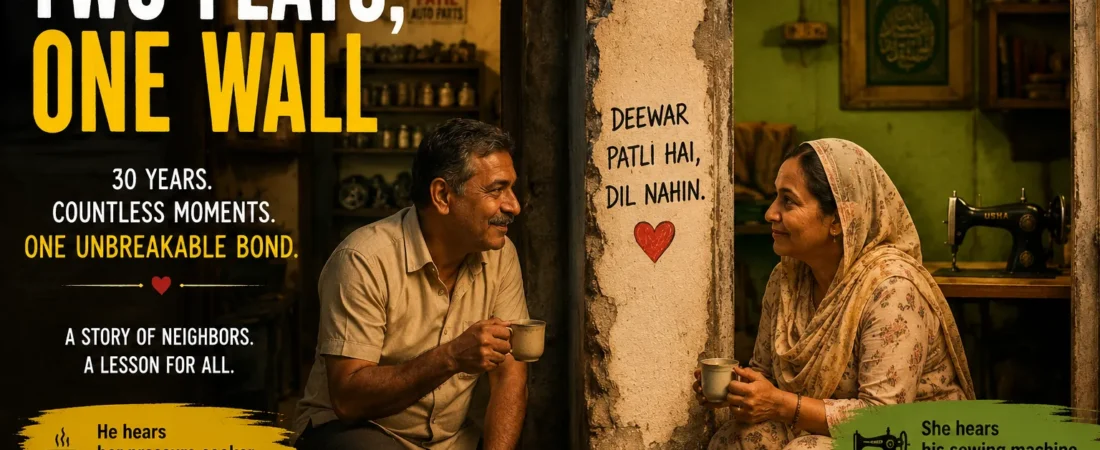
Thirty Years. One Wall. A Lifetime of Trust.

The wall was thin enough to hear everything.
Thirty years of everything.
Suresh Patil knew when Rehana Ansari’s pressure cooker went off every morning at seven. Rehana knew when Suresh’s father used to cough through the night before he died. Both families had heard each other’s weddings, arguments, cricket celebrations, and crying. The wall between Flat 4 and Flat 5 in Noor Chawl, Dharavi, was made of old brick and thin plaster, and it had never once been enough to separate two lives that had grown so close together.
This was simply how it was. For thirty years, this was simply how it was.
Suresh was an auto parts shopkeeper, sixty-one, with a bad knee and a good laugh. His wife Sunanda made the best poha in the building and knew it. Their son Aakash worked in an IT company in Andheri and came home on weekends.
Rehana was fifty-eight, a retired schoolteacher who gave tuitions in the evening to four children from the chawl. Her husband Salim had worked in a textile mill until it closed, and now repaired sewing machines from a small table near the window. Their daughter Zara was studying nursing in Pune.
The two families had never eaten at the same table. They had also never needed to formally decide to be kind to each other. Kindness had simply happened, the way things happen when people share a wall for thirty years.
Sunanda left extra poha outside Rehana’s door on Sunday mornings. Rehana sent vermicelli kheer during Eid without being asked. When Suresh’s father died, Salim sat with him on the floor of the corridor for two hours and said very little. When Salim’s mill closed, Suresh lent him four thousand rupees and never mentioned it again.
The children had grown up running between both flats as if doors were unnecessary.
The election came in November.
It was a municipal ward election — small in the way local elections are small, and large in the way local elections can become large in a chawl where everyone knows everyone. Two candidates were fighting for the ward. One had put up green flags. One had put up saffron flags. Both had loudspeakers. Both had boys on motorcycles who came through the narrow lane outside Noor Chawl every evening, louder each time.
The chawl began to divide in ways Suresh had not noticed before, or perhaps had not wanted to notice.
On the third floor, the Sharma family stopped sharing the staircase landing with the Qureshi family — nothing said, just a new timing to their movements. A WhatsApp group that had been called Noor Chawl Neighbours and used to share electricity bill reminders now had politics in it. First one message. Then ten. Then arguments that went past midnight.
Suresh watched it on his phone and did not reply.
His son Aakash came home one weekend and said, “Papa, you should put up a flag. Show which side we are on. Everyone is doing it.”
Suresh looked at the wall.
He said, “Which side is that?”
Aakash said, “You know which side.”
Suresh did not answer. He went to bed.
A man named Desai, who lived on the ground floor and had recently joined the local wing of one party, knocked on Suresh’s door one afternoon.
He said, “Patil-ji, we are doing a meeting Sunday. You should come. We need Hindu families to stand together in this ward.”
He said it pleasantly, like an invitation to a picnic.
After he left, Suresh stood in his kitchen for a long time. He could hear Salim’s sewing machine through the wall. That small steady sound — it had been the background of his mornings for thirty years.
He thought about the four thousand rupees. He thought about the night his father died and Salim’s hand on his shoulder.
He thought about what standing together meant, and who it required him to stand against.
The Sunday meeting happened. Suresh did not go.
That same evening, someone spray-painted something on the outer wall of the chawl. It was a slogan — not violent, but pointed. It mentioned the election. It was in Hindi. It was aimed at one community.
By morning, everyone in the chawl had seen it.
Rehana did not come out of her flat that day. Suresh noticed this. He noticed Salim’s sewing machine was also quiet — and that absence, that particular silence where a sound had always been, felt louder than anything the loudspeakers had said all week.
He stood at his door for a while. Then he walked the four steps to Flat 5 and knocked.
Rehana opened the door. Her face was careful in the way faces become careful when people are deciding how much to feel.
Suresh said, “I want chai. Sunanda is out.”
It was not true. But Rehana understood it was not meant to be true.
She opened the door wider. He came in and sat in the same chair he had sat in for thirty years. Salim came out from the back room. The three of them sat together and nobody rushed to fill the silence.
When Rehana placed the cup in front of him, Suresh lifted it with both hands — the way his mother had taught him to receive something offered with care. Neither of them spoke. And then, from the back room, the old sewing machine started again, its familiar rhythm moving slowly through the quiet flat. For the first time that week, it sounded like home.
Before he left, Suresh said, “The writing on the wall outside — that is not from me.”
Salim said, “We know.”
The words were small. But in a chawl where walls were thin and everything was heard, small words carried far.
The election came and went. One flag won. The loudspeakers went quiet. The motorcycles stopped coming.
The WhatsApp group slowly returned to electricity bills and water timing complaints. Noor Chawl did not go back to exactly what it was. Some distances that had opened did not fully close. The Sharmas and the Qureshis still moved differently on the staircase.
But the following Sunday morning, Aakash woke early before catching his train back to Andheri. He found his mother’s bowl of poha sitting ready near the door, waiting to be placed outside Flat 5 as always. Sunanda was still asleep.
He picked it up himself. He walked the four steps. He set it gently outside Rehana’s door, straightened up, and left for the station without telling anyone.
He did not think of it as a gesture. He simply did it the way you do something that has always been done — because some things, once learned through a wall, pass quietly from one generation to the next without needing to be explained.
Every Eid, kheer still came the other way.
The wall between them remained thin. Thin enough to hear a pressure cooker. Thin enough to hear a sewing machine start again after days of silence.
Some walls divide homes. The wall between Flat 4 and Flat 5 had spent thirty years teaching two families how not to be divided.
You May Like to Read
One Parking Space: A Neighbor Dispute That Changed Everything
The Lantern That Never Went Out: A Story of Akiya and Kodokushi
The Viral Grandmother: A Story of Food and Fame
The Protest Painter: How One Woman’s Street Art Refused to Be Erased