
|
Getting your Trinity Audio player ready…
|
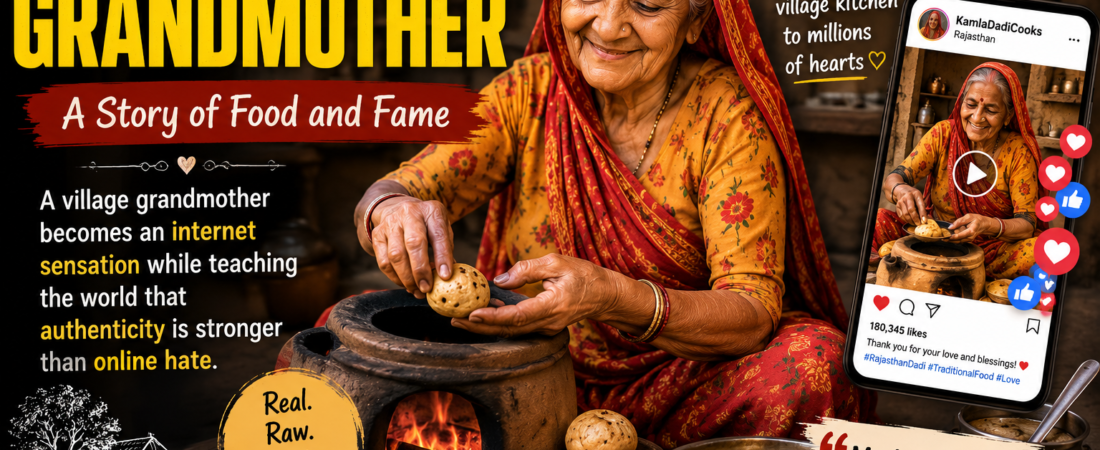
A village grandmother becomes an internet sensation while teaching the world that authenticity is stronger than online hate.
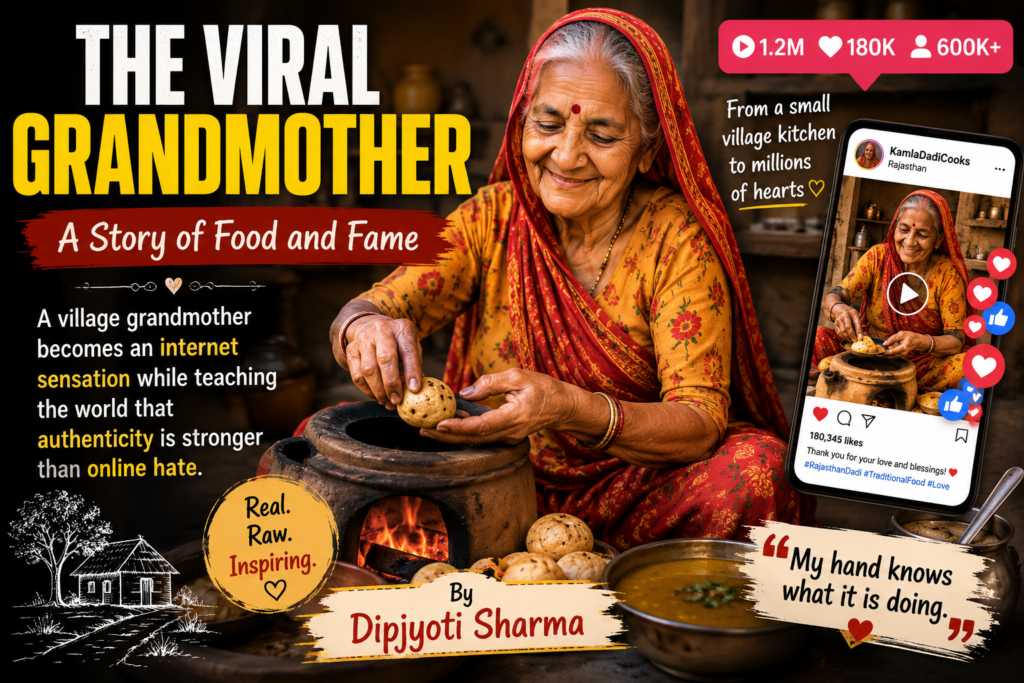
Dadi’s hands had never been still.
For fifty years, Kamla Devi had cooked on a wood fire in a small village outside Jodhpur. She made dal baati churma the way her mother taught her — slow, careful, with ghee that she churned herself on cold mornings. The smell of her kitchen had fed three generations. Nobody outside the village had ever heard of her.
That changed because of her granddaughter Priya.
Priya was twenty-two and had come home after finishing her B.Com in Jaipur. She had 800 followers on Instagram — mostly college friends — and a secondhand phone with a decent camera. One Sunday afternoon, she watched her dadi roll out baati dough with the same steady hands she had watched all her life, and something made her press record.
She didn’t plan it. She just filmed.
Dadi didn’t notice at first. She was talking to herself the way she always did while cooking — little comments, little prayers, little jokes nobody was listening to. “If you rush the dough, the dough knows. It becomes hard like a stubborn husband.” She laughed at her own joke.
Priya uploaded the video with one line of caption: My dadi has been cooking for 50 years and she still talks to the dough.
By morning, it had 40,000 views.
By the end of that week, Kamla Devi — whom the internet had named Rajasthan Dadi — had 180,000 followers.
Priya made a new account just for her. @KamlaDadiCooks. She filmed every morning. Dadi making ker sangri. Dadi making bajra roti. Dadi showing how to make ghee from scratch, laughing when the cream splashed on her nose. She was not performing. That was the thing people could not stop watching — she was just herself, fully and completely, in her own kitchen, in her own village, in her own life.
Comments poured in from everywhere.
This is the most peaceful thing on the internet.
She reminds me of my nani who passed away last year. I am crying.
Please never stop posting.
Brands started emailing Priya. A ghee company from Delhi. A clay cookware brand. A travel company that wanted to do a “village experience” feature. Priya handled everything carefully. She was not greedy. She turned down three offers that felt wrong. She accepted two small ones that paid Dadi more money than the family had seen in a long time.
Dadi did not fully understand what Instagram was. She knew that the little phone was pointed at her. She knew that Priya seemed very busy and very happy. She knew that one morning a large box arrived from Delhi with five types of organic spice and a letter saying “With love from your fans.”
She put the spices on her shelf. She kept cooking.
Four months in, the account had 600,000 followers.
Then one video went differently.
It was a simple video. Dadi was making chicken curry — a recipe she sometimes cooked for the men in the family. She had made it a hundred times. Priya filmed it the same way she filmed everything else.
Within six hours, the comments had changed.
Why is she making non-veg? She is ruining her image.
I thought she was a pure Rajasthani cook. Disappointed.
Unfollow. This is not what we came here for.
And then worse. Comments about her religion. About her caste. About her age. Ugly words that Priya read with her hands shaking.
She deleted the video. But screenshots had already spread to other platforms. People were talking about Rajasthan Dadi on Twitter, not kindly. A man with 50,000 followers posted: “These viral grandmothers are just managed by their grandchildren for money. It’s all fake.”
His followers agreed loudly.
Priya did not sleep that night.
She did not know what to do. She was not a PR person. She was not a manager. She was a girl from a village who had filmed her grandmother cooking because it was beautiful and she wanted people to see it.
In the morning, she went to the kitchen.
Dadi was already there, making chai. She looked at Priya’s face and said, “You look like you swallowed a lemon. Sit.”
Priya sat. She told her everything. The chicken video. The comments. The man who said it was all fake. She translated some of the words, gently.
Dadi listened. She poured the chai. She pushed a cup toward Priya.
Then she said, “And what did I do wrong?”
Priya said, “Nothing, Dadi.”
“Then why are you crying?”
“Because they are saying bad things about you.”
Dadi was quiet for a moment. She looked at the fire. Then she said, “Priya. In fifty years, people have said I put too much salt, too little chilli, too much ghee, not enough ghee. Neighbors have talked. In-laws have talked. Let these phone people also talk. My hand knows what it is doing.”
Priya wiped her face. She picked up her phone.
She did not post an apology. She did not explain. She posted a new video.
It was Dadi, the next morning, making chai. Simple. Quiet. No music. No caption except: She’s fine. She’s cooking. Good morning.
Within two hours, 200,000 people had watched it.
The comments this time said:
Tell Dadi we love her.
We are with you.
The haters are scared of something real.
Priya read each one. She did not show them all to Dadi. Some things, she decided, were for her to carry.
But one comment she did read out loud at dinner.
An old woman from Lucknow had written: “Beta, your dadi cooks like my dadi cooked. Don’t let anyone take that from us.”
Dadi heard it. She nodded slowly, the way she nodded when something tasted exactly right.
Then she got up to check on the dal.
It was still simmering. Patient, and slow, and completely itself.
You May Like to Read
One Parking Space: A Neighbor Dispute That Changed Everything
The Lantern That Never Went Out: A Story of Akiya and Kodokushi